
Your Next Commercial Lease Is a Business Decision—Not Just a Real Estate Decision
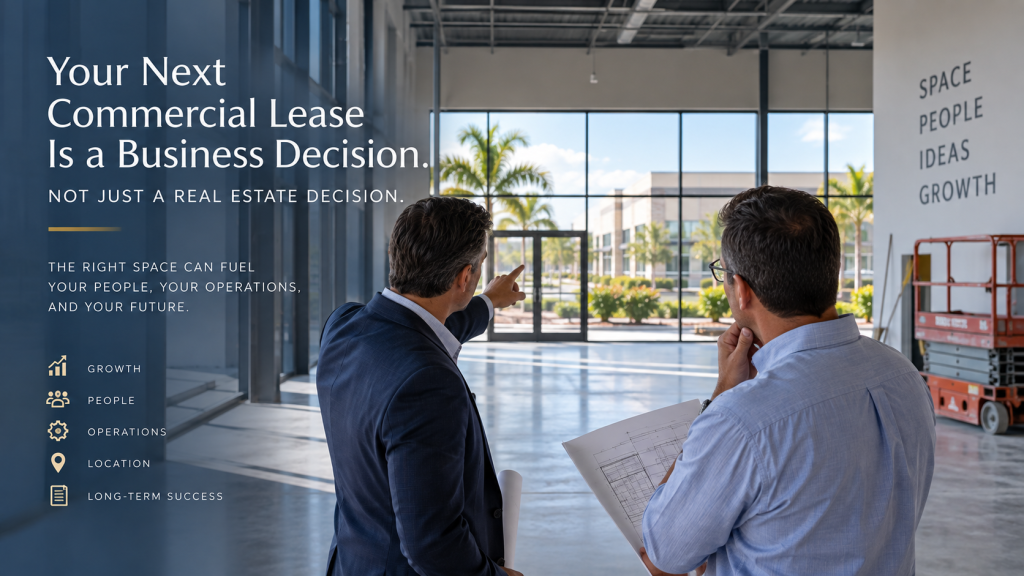
Growth is exciting. More employees, more customers, more inventory, new equipment, a second location, or an entirely new market can all eventually lead a successful business to the same conclusion: we need more space.
Before beginning the property search, however, I would encourage an entrepreneur to ask a slightly different question: What does our business need from its next space?
A commercial lease can become one of the largest and longest financial commitments a company makes. For an established business entering a 7- or 10-year lease, the total obligation can easily reach hundreds of thousands—or millions—of dollars before considering improvements, operating expenses, equipment, relocation costs, and future rent increases.
That’s why I believe the search should begin with the business, not the available listings.
Start With the Business You Expect to Become
It’s relatively easy to determine how much space your business occupies today. The harder question is what you’ll need three, five, or ten years from now.
Consider future employees, inventory, equipment, customer areas, storage, parking, loading, technology, and workflow. Could you acquire another company? Add another division? Need significantly more electrical capacity? Could this location eventually serve as a regional operation?
The goal isn’t to lease enough space for every imaginable possibility. Paying for unused square footage for years isn’t good planning either. The objective is finding the appropriate balance between today’s economics and tomorrow’s opportunity.
For larger companies considering substantial build-outs and longer lease terms, this planning becomes even more important. Once significant capital is invested into a facility, relocating again prematurely can become extraordinarily expensive.
The Lowest Rent May Not Be the Lowest-Cost Location
Entrepreneurs are trained to control and negotiate expenses. That’s generally a good instinct, but commercial space shouldn’t be evaluated by rental rate alone.
Consider a lower-cost location that creates longer employee commutes, inadequate parking, poor truck access, limited visibility, inefficient workflow, or significant build-out requirements. Compare that with a more expensive location that improves productivity, customer accessibility, recruiting, logistics, visibility, or operational efficiency.
Which one actually costs more?
Sometimes the answer is obvious. Sometimes it requires considerably more analysis.
The cheapest space isn’t necessarily the least expensive business decision.
Understand the Entire Occupancy Commitment
Base rent is only the beginning. Depending on the property and lease structure, a tenant may also be responsible for some combination of property taxes, insurance, Common Area Maintenance (CAM), utilities, repairs, HVAC maintenance, janitorial services, security, signage, and other expenses.
Then consider what it costs to actually occupy the space: tenant improvements, furniture, fixtures, equipment, technology infrastructure, moving, permitting, signage, and potentially operating two locations during the transition.
For a substantial lease, I want an entrepreneur thinking less about “What’s my monthly rent?” and more about “What is my total occupancy commitment over the life of this lease?”
That is a much better business question.
A Longer Lease Can Be Both a Risk and an Asset
A 10-year lease is a significant commitment. But for an established company investing heavily in its location, a longer term can also provide stability, protect the investment made in the space, support landlord contributions toward improvements, and reduce the risk of being forced to relocate after building a successful operation.
The real question isn’t whether a long lease is good or bad. It’s whether the structure supports the business.
Renewal options, rent escalations, expansion opportunities, assignment and subleasing provisions, signage, parking, maintenance responsibilities, and other negotiated terms can become extremely important over a long occupancy period. If you eventually sell the business, merge, recapitalize, or acquire another company, the lease may become an important part of that transaction.
The lease you negotiate today can either create flexibility—or remove it—years from now.
Before You Start Touring Properties…
If you’re already recognizing that your next lease involves considerably more than finding the right square footage, this is a good time for us to talk.
I can help you define what the business actually needs, establish search criteria, understand the market, evaluate available properties, compare the economics, and represent your interests throughout the leasing process.
The earlier I’m involved, the more opportunity we have to plan rather than react.
Tenant Improvements Can Change the Economics
A raw or outdated space may require substantial investment before the business can operate. Depending on the property, tenant, market conditions, and lease term, an owner may be willing to contribute toward approved improvements through a Tenant Improvement (TI) allowance.
But TI isn’t simply “free money.” The improvement package, rental rate, lease length, commencement date, rent concessions, and other economics should be evaluated together.
This is one reason sophisticated tenants shouldn’t negotiate individual lease terms in isolation. The entire economic package matters.
The Right Location Depends on the Business
A retailer may prioritize visibility, demographics, access, and customer traffic. A medical practice may place greater emphasis on parking, accessibility, plumbing, and patient convenience. An industrial company may care far more about loading, clear height, power, yard space, transportation access, and employee proximity. A professional office user may prioritize image, technology, accessibility, and recruiting.
There is no universally “best” commercial location. There is a location that best supports your particular business model, people, customers, operations, and future plans.
That’s also why your commercial real estate representative should understand the business before showing you properties.
Give Yourself Something Valuable: Time
One of the greatest advantages a commercial tenant can have is time. When an existing lease is approaching expiration, choices can disappear very quickly.
Finding suitable space takes time. Negotiating business terms takes time. Attorneys need time to review documents. Construction plans, permits, tenant improvements, inspections, equipment installation, technology, and moving all take time.
A company considering a significant relocation, expansion, or large long-term lease should begin planning well before it believes it needs to move.
Time creates options. Urgency removes them.
Why Tenant Representation Matters
A landlord typically enters a lease negotiation knowing what it wants. Ownership understands the property, its economics, its preferred lease structure, and usually has experienced representation.
The tenant deserves the same level of preparation.
When I represent a tenant, my job isn’t simply searching databases and unlocking doors. I want to understand where the business is today, where ownership wants it to go, what the company can comfortably afford, which property characteristics are essential, where flexibility exists, and where compromising could create problems later.
From there, we can evaluate opportunities, compare economics, negotiate business terms, coordinate with the other professionals involved, and help keep the process moving toward the company’s objective.
For larger leases, experienced representation can become even more consequential. Seemingly small differences in rental rates, escalations, improvement allowances, operating expenses, or other terms can become substantial when multiplied across tens of thousands of square feet and a 10-year lease.
You should have someone at the table thinking about the real estate through the eyes of your business.
The Right Space Should Help Your Business Become Better
I spent many years as a business owner myself, so I tend to look at commercial space differently. I’m certainly interested in the building, but I’m even more interested in what happens inside that building.
Can your people work efficiently? Can your customers reach you? Can you recruit and retain employees? Can the business grow? Can you comfortably support the occupancy costs through both strong and challenging years? Does the location improve the business—or simply house it?
Because ultimately, you’re not really leasing square footage.
You’re choosing where the next chapter of your business will happen.
Planning Your Next Space?
If your business is expanding, relocating, opening another location, or beginning to evaluate a substantial long-term commercial lease in Southwest Florida, I’d welcome the opportunity to learn what you’re trying to accomplish.
We can start with your business requirements first and the available properties second. When you’re ready to search, evaluate, and negotiate, you can rely on me to bring both a business owner’s perspective and the broader market knowledge, experience, and resources of the CRE Commercial Group team to the table.
The objective isn’t simply finding your next space. It’s helping you make the right business decision about where your company goes next.