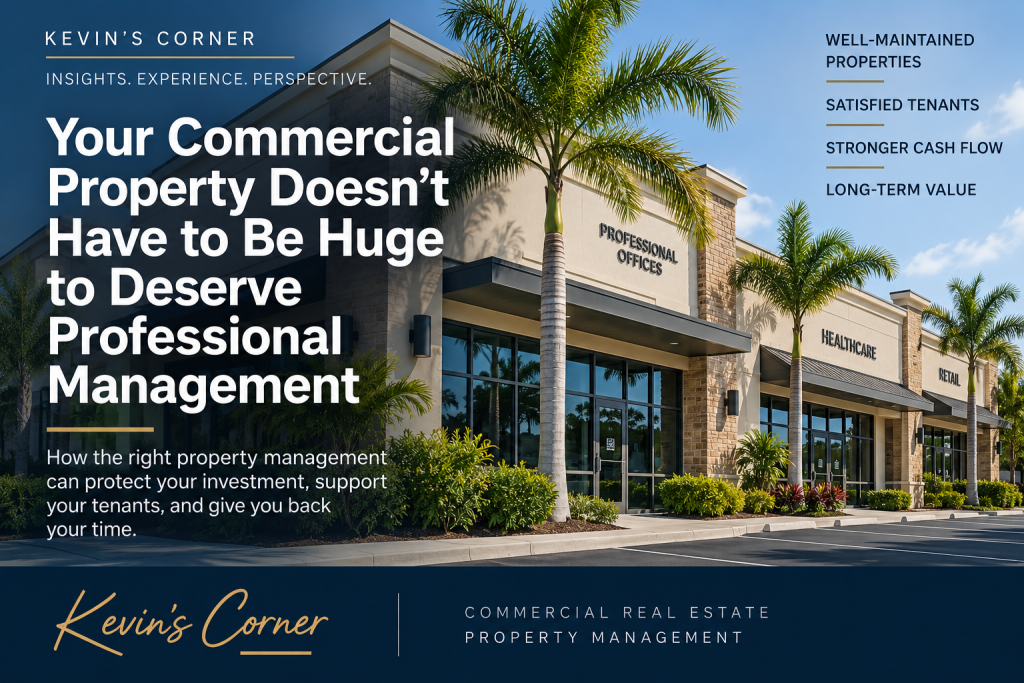
Your Commercial Property Doesn’t Have to Be Huge to Deserve Professional Management
Commercial property management is sometimes associated with enormous office towers, sprawling industrial portfolios, or institutional owners with hundreds of thousands of square feet under management.
But some of the properties where professional management can make the greatest difference are considerably smaller.
It may be a 7,000-square-foot building occupied by one or two tenants. It could be a neighborhood retail property, a professional office building, a medical office building, or a multi-tenant commercial property with 10, 15, or 20 businesses under one roof.
These properties may not be institutional in size, but they’re certainly meaningful investments to the people who own them. And the management challenges are very real.
At What Point Does Owning the Property Become Another Job?
A smaller commercial property can look relatively straightforward from the outside: collect the rent, pay the bills, keep the building maintained, and respond when something goes wrong.
In practice, those responsibilities accumulate quickly. There are leases and renewals to monitor, rent and expense reimbursements to collect, vendors to coordinate, invoices to review, financial records to maintain, tenant questions to answer, preventive maintenance to schedule, capital improvements to plan, and vacancies that eventually need attention.
For a single-tenant owner, one lease expiration can affect virtually the entire property’s income. For a 16-tenant property, the owner may be managing 16 different relationships, lease structures, renewal dates, maintenance concerns, and operating needs.
The relevant question isn’t really how large the building is. It’s whether managing it is the best use of the owner’s time, attention, and expertise.
Good Property Management Has a Financial Side
One aspect of commercial property management that owners sometimes underestimate is how much it involves accounting and financial management, not simply maintaining the physical building.
Professional management can include accounts receivable and payable, budgeting, monthly financial reporting, lease administration, expense management, capital-improvement planning, and monitoring the property’s overall financial performance.
For an owner, that should translate into something very practical: knowing how the property is actually performing.
Are rents being collected? Are expenses consistent with expectations? Are recoverable costs being handled correctly? What significant expenditures are approaching? Is cash flow changing? Are capital needs being anticipated rather than discovered?
Professional management should give an owner better information, not merely fewer phone calls.
The Building Still Has to Work
Of course, financial reporting doesn’t fix an air conditioner.
Commercial buildings require ongoing physical management as well. Preventive maintenance, general repairs, HVAC, roofing, lighting and electrical systems, storm preparation, vendor coordination, tenant improvements, security, and other operating needs all become part of protecting the asset.
The objective isn’t to spend the least possible amount on a property. It’s to spend intelligently—addressing issues before they become larger problems, obtaining appropriate services at competitive costs, and maintaining the property in a manner that supports both tenants and long-term value.
Medical Office Buildings Deserve Particular Attention
Medical office buildings, often referred to as MOBs, are a particularly interesting example.
Whether a building contains a single healthcare practice or multiple medical tenants, the property may have specialized operating requirements that go beyond conventional office space. Patients need dependable access and parking. Practices may have substantial investments in their suites. Plumbing, HVAC, electrical capacity, accessibility, signage, and other building systems can directly affect daily operations.
Tenant relationships matter, too. A building problem can affect scheduled patients and the operation of a healthcare practice, making responsive management, preventive maintenance, vendor coordination, lease administration, and clear financial reporting particularly valuable.
A medical office building doesn’t have to be enormous to be operationally sophisticated.
The Tenant Experience Eventually Becomes the Owner’s Experience
Tenants generally don’t call the property owner when everything is going well. They call when something isn’t.
A maintenance request wasn’t handled. Communication was poor. A common area needs attention. An HVAC problem keeps recurring. They don’t understand a charge. Their lease renewal is approaching, and nobody has initiated a conversation.
Those issues can eventually become owner issues through tenant dissatisfaction, difficult renewals, or vacancy.
A good property manager becomes the owner’s day-to-day presence at the property without separating the owner from important decisions. The owner remains informed and in control, while someone else is responsible for keeping routine matters from becoming unnecessary distractions.
Is Your Property Taking More of Your Time Than It Should?
If you own a commercial property and find yourself increasingly involved in accounting, rent collection, tenant communication, repairs, vendors, lease administration, or maintenance issues, it may be worth evaluating whether your current approach is still serving you well.
The same applies if you already have a property-management company but aren’t receiving the responsiveness, financial reporting, tenant relations, or level of attention you expect.
I’d be happy to have a confidential conversation about your property, how it’s currently being managed, and what you would want professional management to accomplish.
Vacancies Shouldn’t Live in a Separate World
Property management and leasing are often treated as separate services, but from an owner’s perspective they’re closely connected.
A property manager may see warning signs before a space becomes vacant. A tenant may be struggling, considering expansion, approaching expiration, or becoming dissatisfied. Early communication may create an opportunity to retain the tenant, restructure the relationship, or begin preparing for a vacancy before the keys are returned.
When space does become available, leasing activity directly affects the property’s financial performance. The objective should be continuity: manage the property well, retain good tenants where possible, address vacancies proactively, and keep the asset performing.
Professional Management Should Give the Owner Something Back
There is a financial return associated with good management, but there can also be a return that doesn’t appear on the operating statement: time.
Many commercial property owners are also business owners, executives, investors, professionals, or retirees. They didn’t necessarily acquire commercial real estate because they wanted another operational job.
Professional management should allow an owner to remain informed and involved in meaningful decisions without personally coordinating every repair, collecting every payment, answering every tenant question, or reconciling every expense.
The goal isn’t to disconnect the owner from the property. It’s to provide better oversight with less day-to-day burden.
Maybe Your Property Is Exactly the Right Size
At CRE Commercial Group, we’re interested in helping owners of commercial properties that sometimes fall between two worlds: too important and operationally involved to manage casually, but not enormous institutional assets requiring an army of people.
That can include single-tenant properties, smaller and mid-sized multi-tenant buildings, professional and medical office buildings, retail properties, and other commercial assets throughout Southwest Florida.
Our property-management capabilities include financial management and accounting, tenant relations, lease administration, repairs and preventive maintenance, vendor coordination, project and capital planning, leasing support, and the broader commercial real estate resources of the CRE team.
If you own a commercial property and would like to spend less time managing the management, I’d welcome the opportunity to learn about the property and what you want it to accomplish for you.
Your building doesn’t have to be enormous to deserve professional attention. It only has to be important to you.