Thinking About Selling Your Commercial Property? Start With Who Might Want to Buy It
Commercial property owners usually know their buildings extremely well. They know the improvements they’ve made, the tenants they’ve worked with, the repairs they’ve completed, the neighborhood, and often the history of the property going back years or even decades.
But when it’s time to consider selling, there’s another perspective that becomes equally important:
How will the next owner look at the property?
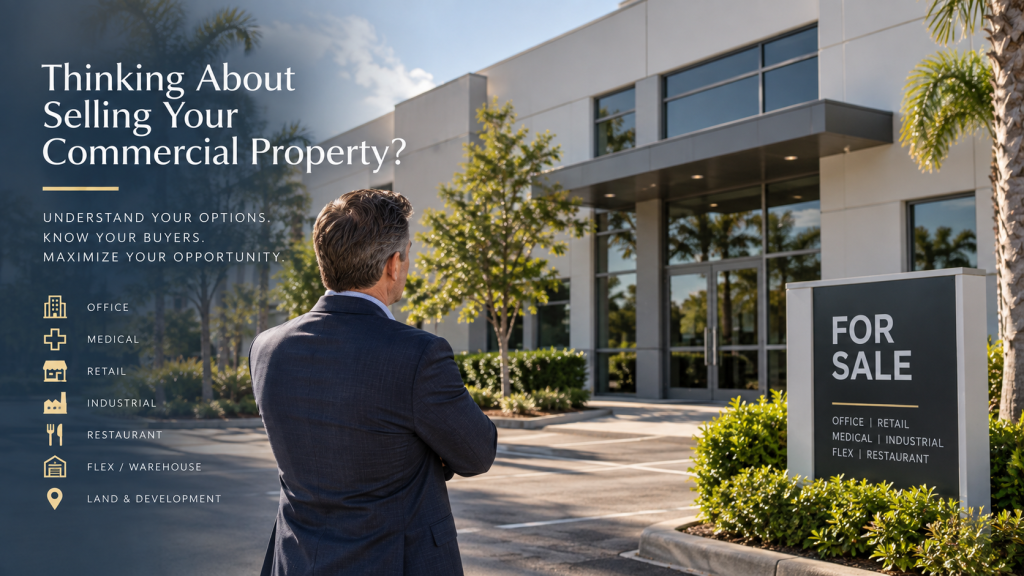
A medical office, industrial building, retail center, restaurant, professional office, warehouse, or owner-occupied property may each attract very different buyers. Understanding who those buyers are—and what they value—is an important part of positioning a commercial property for the market.
Commercial Property Isn’t One Market
“Commercial real estate” describes an enormous range of properties. A medical facility with plumbing throughout the building is fundamentally different from a warehouse requiring loading access and clear height. A restaurant may derive substantial value from an existing kitchen, hood system, grease trap, seating configuration, parking, and possibly other infrastructure that could be expensive for another operator to recreate. Retail buyers may focus heavily on visibility, traffic, access, parking, surrounding demographics, and neighboring businesses.
Office properties introduce another set of considerations: layout, location, parking, building image, technology, accessibility, and whether the improvements suit today’s professional users. Industrial and flex properties may be evaluated around power, loading, ceiling height, yard space, vehicle access, warehouse-to-office ratio, and proximity to transportation corridors. Mixed-use and multi-tenant investment properties add yet another layer involving leases, operating expenses, tenant quality, occupancy, and income.
Your property isn’t simply competing against “commercial properties for sale.” It’s competing within a particular market for a particular buyer. Your Knowledge Library reflects this same distinction across office, retail, industrial, warehouse, medical, mixed-use, and owner-user properties.
Why Do Commercial Property Owners Sell?
Sometimes the answer is obvious. An owner is retiring, relocating, dissolving a partnership, selling the operating business, or simplifying an investment portfolio. In other situations, the decision is more strategic.
An investor may have substantial equity tied up in a mature asset and believe that capital could produce a better return elsewhere. A business owner may have outgrown the building—or no longer need as much space. Another owner may be facing significant future capital improvements, changing market conditions, or simply reaching a stage of life where managing property is no longer how they want to spend their time.
There are also owners who aren’t certain they should sell at all. They may be better served by improving the property, filling vacancies, restructuring leases, refinancing, retaining the real estate after selling the operating business, or simply continuing to hold a strong-performing asset.
That’s why I don’t believe the first conversation should necessarily be, “What should we list it for?”
A better starting point is often: “What are you trying to accomplish?”
Who Is the Buyer?
For many commercial properties, there are two broad buyer groups: investors and owner-users.
An investor is purchasing an income-producing asset. That buyer will typically examine NOI, leases, rental rates, operating expenses, tenant strength, lease expirations, future capital requirements, and opportunities to increase income or reduce risk. A property with quality tenants and well-structured leases may be particularly attractive because the buyer is purchasing a future stream of income as much as the physical real estate. Your Business & Property Value FAQs appropriately emphasize that sustainable NOI, lease structure, and tenant quality can materially influence how investors perceive an asset.
An owner-user sees the same property differently. That buyer may care far more about whether the building supports the company’s operations. Is there enough parking? Can equipment be accommodated? Is the location convenient for employees and customers? Can the business expand? Is the zoning appropriate? Would the existing build-out save significant time and capital?
Then there are developers and value-add buyers who may see something entirely different. They may be interested in excess land, redevelopment potential, below-market rents, vacancies, alternative uses, or the ability to reposition an aging asset.
Same property. Different buyers. Different definitions of value.
That is one of the reasons identifying the likely buyer matters before determining how a property should be positioned.
Before You Put a Price on the Property…
This is often where I can provide the most value before an owner commits to selling.
We can look at the property, its current use, comparable transactions, income where applicable, leases, physical condition, location, potential buyer profiles, and current market conditions. Then we can discuss not only a probable pricing range, but how the property might best be positioned and whether anything deserves attention before it reaches the market.
Sometimes the right recommendation is to sell now. Sometimes a few thoughtful steps may create a stronger offering. And occasionally, the conversation reveals that selling isn’t presently the owner’s best option.
If you’re beginning to wonder what your commercial property might command in today’s market, that’s a conversation we can have confidentially before you make any decisions.
Selling the Building Can Be More Complicated When You Also Own the Business
Owner-users face an especially interesting decision because they may own two valuable assets: the operating business and the commercial real estate.
Those assets don’t necessarily have to be sold together.
A retiring business owner might sell the company but retain the building and lease it to the buyer, creating an ongoing income stream. Another owner may prefer a clean exit and sell both. In some circumstances, the real estate may appeal to a broader market without the business attached, while in others, the location and business are so interconnected that marketing them together deserves consideration.
There is also the possibility of a sale-leaseback, where an operating company sells its real estate but continues occupying the property under a new lease. Depending on the circumstances, that can unlock capital while allowing the business to remain in place.
These aren’t simply real estate questions. They’re business, financial, and lifestyle decisions, which is why I believe they should be considered together rather than automatically assuming there is only one way to exit.
Preparation Can Affect the Outcome
One of the biggest mistakes a seller can make is waiting until the property is listed to discover what a buyer will notice.
Incomplete financial records, deferred maintenance, unresolved tenant issues, short lease terms, unclear expense histories, or missing property information can introduce uncertainty during due diligence. Buyers rarely pay a premium for uncertainty.
For an investment property, preparation may mean organizing leases, rent rolls, operating statements, capital improvement histories, and maintenance records. For an owner-user building, it may involve understanding zoning, permitted uses, property condition, improvements, parking, access, and which types of businesses could realistically use the property.
That doesn’t mean every seller should spend substantial money renovating before going to market. In fact, an improvement that makes sense to the current owner may have little value to the next one. The better question is whether an improvement is likely to increase marketability, reduce buyer concerns, improve income, or strengthen negotiating position.
Preparation isn’t about making everything perfect. It’s about reducing unnecessary questions and giving qualified buyers confidence in what they’re evaluating. Your value-oriented FAQs make the same point: comparable transactions matter, but so do income, lease quality, condition, buyer demand, and the market evidence surrounding the asset.
The Highest Price Begins With the Right Strategy
When owners think about selecting a commercial real estate broker, it’s natural to focus on exposure: Where will the property be advertised? Who will see it? How many websites will it appear on?
Those things matter, but marketing begins before the advertisement.
Who is the likely buyer? What does that buyer care about? Which features of the property create the most value? What objections are we likely to encounter? How does the property compare with competing opportunities? Should we target investors, owner-users, developers, or more than one group? What information will buyers need to make a confident decision?
That’s where I believe experienced representation earns its place.
I bring the perspective of someone who spent decades operating businesses and understands commercial property through both the real estate and business-owner lens. Behind me is the broader market knowledge, transaction experience, research capability, and professional resources of CRE Commercial Group.
The objective isn’t simply to put your property on the market.
It’s to understand what you own, identify who is most likely to value it, position it thoughtfully, and pursue the strongest outcome the market will support.
Thinking About Selling?
Whether you own a medical office, industrial facility, retail property, restaurant building, professional office, warehouse, multi-tenant investment, or the real estate occupied by your own business, the conversation can begin long before you’re ready to sign a listing agreement.
If you’re considering selling now—or simply wondering whether the time may be approaching—I’m happy to help you understand the property, the likely buyer pool, the current market evidence, and the options available to you.
No pressure to sell. No assumption that selling is necessarily the answer.
Just a thoughtful conversation about where you are, what you own, and what you’d like to accomplish next.